2026 Ford Bronco® vs. Bronco Sport®: Two Very Different Approaches to Adventure
The 2026 Ford Bronco® and Bronco Sport® share a name and some deliberately similar styling, but mechanically they're quite different vehicles. The Bronco® is a body-on-frame midsize SUV engineered around serious off-road capability, while the Bronco Sport® is a smaller unibody compact SUV with more modest dimensions and a different set of priorities. For Hamden, CT, drivers, the choice becomes clearer once you look beyond the styling and examine the construction, engines, chassis hardware, and towing capacity.
Body-on-Frame vs. Unibody Construction
The Bronco® comes in 2-door and 4-door configurations and adds removable doors and an available removable roof, giving it an open-air character the Bronco Sport® doesn't attempt to replicate. The Bronco Sport® is exclusively a 4-door, 5-passenger SUV, with compact dimensions that make it easier to place in tighter streets and parking spaces. Its unibody construction also separates it fundamentally from the Bronco's truck-like body-on-frame architecture. These aren't simply large and small versions of the same SUV.
The Off-Road Hardware Reveals Their Different Missions
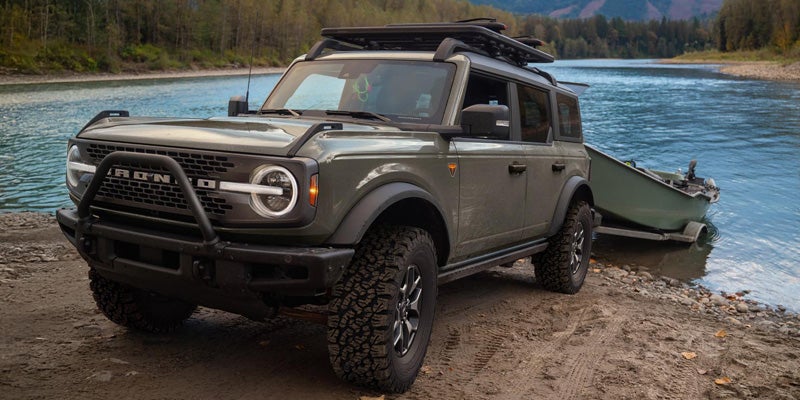
Both come standard with 4x4, but the similarities quickly end. The Bronco® combines independent front suspension with a solid rear axle and offers front and rear electronic-locking differentials, a front stabilizer bar disconnect, and the available Sasquatch® Package. Bronco Raptor® takes the concept farther with specialized off-road equipment and 37-inch all-terrain tires. Bronco Sport® Big Bend®, Heritage, and Outer Banks® models use standard 4x4, while Badlands® adds an advanced 4x4 system with a twin-clutch rear drive unit, HOSS 2.0 Off-Road Suspension, Trail Control™, and 7 G.O.A.T. Modes®. Available Sasquatch® packages expand its trail equipment further.
Engine Output Creates Another Clear Divide
Bronco Sport® starts with a 1.5L EcoBoost® 3-cylinder producing 180 hp and 200 lbs. ft. of torque in Big Bend®, Heritage, and Outer Banks®. Badlands® gets a 2.0L EcoBoost® 4-cylinder with 250 hp and 280 lbs. ft. of torque. Both engines use an 8-speed automatic transmission. The Bronco® begins considerably higher with a 2.3L EcoBoost® 4-cylinder producing 300 hp and 325 lbs. ft. of torque. Its available 2.7L EcoBoost® V6 produces 330 hp and 415 lbs. ft. of torque, while Bronco Raptor® employs a 3.0L EcoBoost® V6 with 418 hp and 440 lbs. ft. of torque.
Towing Capacity Follows the Same Pattern
Bronco® models equipped with the 2.3L or 2.7L engine can provide up to 3,500 lbs. of towing capacity when properly equipped, while Bronco Raptor® increases maximum conventional towing capacity to 4,500 lbs. Bronco Sport® models with the 1.5L EcoBoost® and available Class II Trailer Tow Package can tow up to 2,200 lbs. Badlands® pairs its standard Class II Trailer Tow Package with the 2.0L EcoBoost® for up to 2,700 lbs. of towing capacity.
The Bronco Sport® Has an Everyday Advantage
The Bronco Sport's smaller footprint and crossover construction make sense for drivers spending most of their time on pavement while still wanting genuine off-road equipment available for weekends. Models with the 1.5L engine return an EPA-estimated 25 mpg city and 30 mpg highway. The Bronco® gives up some of that compact-SUV character in exchange for greater power, specialized trail hardware, removable body panels, and a chassis conceived around more demanding terrain.
Compare Both SUVs at Bob Thomas Ford Inc
Bob Thomas Ford Inc gives Hamden, CT, shoppers the opportunity to compare current Bronco® and Bronco Sport® inventory side by side. Examine the size, powertrains, 4x4 hardware, towing ratings, and cabin packaging before deciding which approach fits your driving. Schedule a test drive to experience how differently these 2 Ford® SUVs translate the Bronco® name.